RSS

Author Archives: Susan Davis Faulkner

Ernest Lorenzo Boling (1916-2006)

Ernest Lorezo Boling was born on May 4, 1916.

He married Nora Lee Wooten.

He died on November 17, 2006 in Coldwater, Mississippi.


The following obituary was shared on Find A Grave memorial page without publication information.

Ernest L. Boling, 90, passed away November 17, 2006 at his home in Coldwater, MS. He was a retired Press Operator with Chromcraft Corporation and a member of the Coldwater Church of Christ. Mr. Boling is survived by his wife, Nora Lea Boling of Coldwater, and his sister Allene Powell of Morristown, TN. He is also survived by one daughter, Ruth Boling Brister of Senatobia, MS and one daughter-in-law, Karla Shaffer Boling of Montgomery, AL. He leaves two granddaughters, Laret Boling Casella and her husband Jeff of Nashville, TN, and Elizabeth Brister Baker and her husband Caleb of Forrest City, AR. Mr. Boling also leaves two grandsons, Shon Karl Boling and his wife Kelly of Elmore, AL, and Ron Larry Boling and his wife Joann of Dessemer City, NC. One great-grandson, seven-year-old Alex Boling of Elmore, AL. Mr. Boling is preceded in death by his only son, Ernest Larry Boling. Services were held at 10:00 a.m. Tuesday, November 21, 2006 at Coldwater Church of Christ with Billy Bland officiating. The burial followed at Crockett Cemetery in Crockett, MS. The family requests memorials be made to Coldwater Church of Christ Building Fund. Pate-Jones Funeral Home in Senatobia had charge of the services.

 
Comments Off on Ernest Lorenzo Boling (1916-2006)

Posted by on 15 July 2017 in Faulkner Family Farm


Forrest Eugene Bell (1929-2006)

Forrest Eugene Bell was born on June 23, 1929 in Lubbock, Texas to Leonard Evan Bell and Era Viola Hacker.

He married Cleta Morton in Lubbock, Texas on February 14, 1948.

He died on May 14, 2006 in Lubbock, Texas.


Obituary offered on Find A Grave memorial webpage without publication information.

Forrest Eugene Bell passed away Sunday May 14th. He was born in Lubbock on June 23, 1929 to Leonard Happy and Era Hacker Bell. He was one of five brothers

Forrest Married Cleta Morton, Feb. 14, 1948 in Lubbock at the First Nazarene Church.

Forrest was a stone mason and had laid brick since the age of sixteen. He established Forrest Bell Masonry, a successful business until his retirement several years ago.

Forrest is survived by his wife of 58 years, Cleta Morton Bell; two brothers Bobby and Windell Bell; a daughter Donna White and son-in-law George White; daughter Debbie Henry and son-in-law Chris Henry; son, David Bell and daughter-in-law Rebecca Bell. He found great joy in his five grandchildren and his seven great grandchildren.

Mr. Bell was a Christian and was raised in the Nazarene Church.

Graveside services will be 11a.m., Wednesday May 17th in the City of Lubbock Cemetery with Pastor Ray Hill of the Five Stones Fellowship Church officiating

 
Comments Off on Forrest Eugene Bell (1929-2006)

Posted by on 15 July 2017 in Faulkner Family Farm


Bobby Lester Bell (1927-2013)


Bobby Lester Bell was born on December 16, 1927 in Lubbock, Texas to Leonard Evan Bell and Era Viola Hacker.

He married Ella Wese Hooker on April 23, 1948 in Lubbock, Texas.

He died on January 20, 2013 in Lubbock, Texas.


Obituary published in the Lubbock Avalanche-Journal (Lubbock, Texas) on January 22, 2013.

Bobby L. Bell, 85, of Lubbock departed this life for his Heavenly Father’s House on Sunday, January 20, 2013. Services will be at 2 p.m. Wednesday, January 23, 2013, at the South Plains Church of Christ, Mr. Jim Brewer, minister, will officiate. Burial will follow at the City of Lubbock Cemetery under the direction of Rix Funeral Directors. Bobby was born on December 16, 1927 in Lubbock to Leonard E. and Era Viola Hacker Bell. He graduated from Lubbock High School in 1945 and then joined the U. S. Marines. After his discharge, he returned to Lubbock and married Ella Wese Hooker on April 23, 1948 in Lubbock. He was a plumbing contractor and owned his own business, Bobby Bell Plumbing Company. His wife of 62 years preceded his in death on December 19, 2010. He was a member of the South Plains Church of Christ. Bobby is survived by his two sons, Danny Bell and daughter-in-law, Kelly of Lubbock, and J. Ted Bell and wife, Dina of La Grange, Texas; and brother, J. W. (Windell) and wife, Gene Bell of Lubbock. He was affectionately known as Dedee to seven grandchildren, 15 great-grandchildren, and all of his neighbors and friends.

 
Comments Off on Bobby Lester Bell (1927-2013)

Posted by on 15 July 2017 in Faulkner Family Farm


Roy Alfred Faulkner (1906-1970)

Roy Alfred Faulkner was born on February 21, 1904 in Cherokee Nation, Indian Territory to  George Alfred Faulkner and Maude May Weatherly.

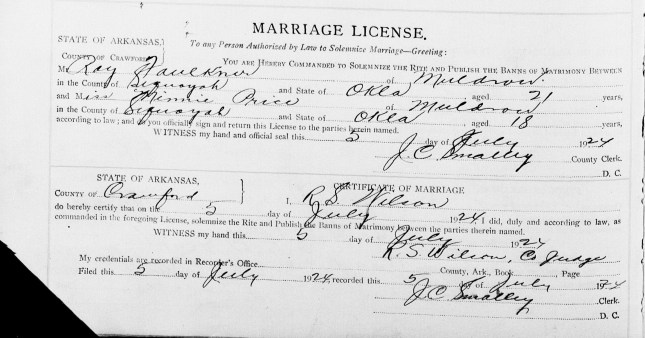
He married Minnie Arizona Price on July 5, 1924 in Crawford County, Arkansas.

They were the parents of Minnie Helen Faulkner, Mary Ellen Faulkner, Marie Faulkner, Jack Price Faulkner, and Peggy Ruth Faulkner.

He died on May 4, 1970 in Muldrow, Oklahoma.


FaulknerPriceMC

Marriage Certificate of Roy Faulkner and Minnie Price. Arkansas, Crawford County, Marriage Book K (June 1947-May 1948), page 354.


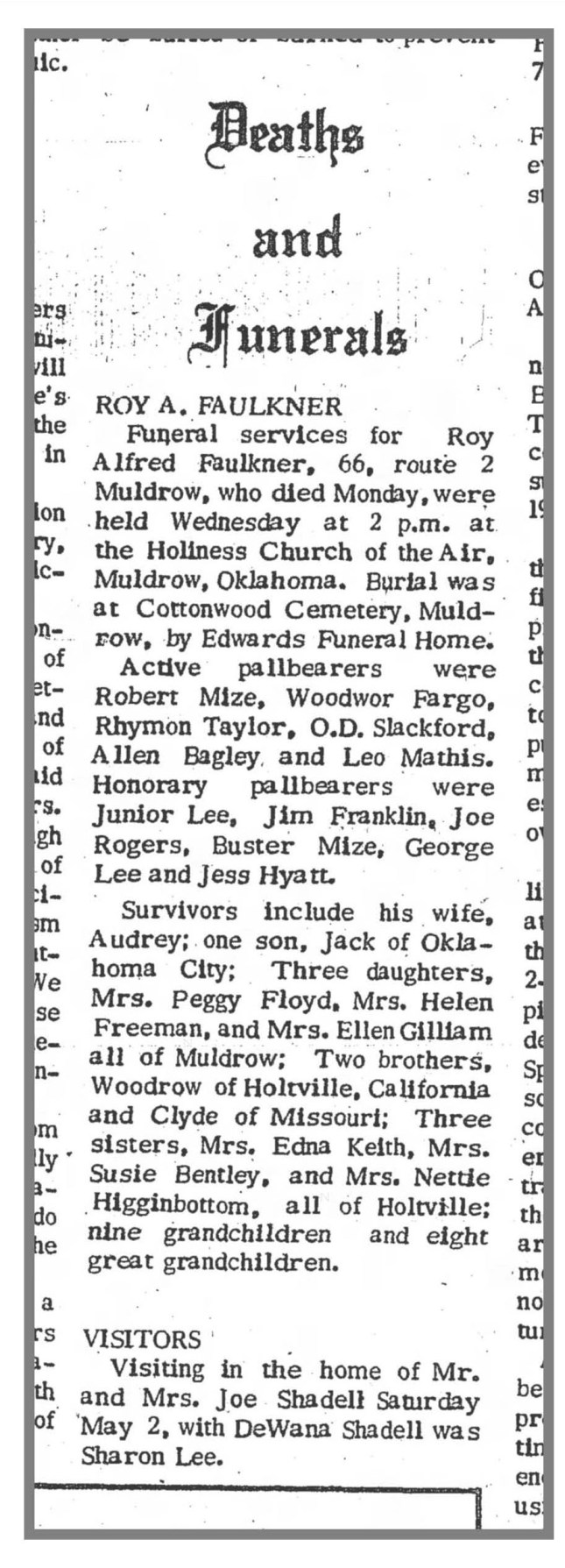
The obituary of Roy Alfred Faulkner was published in the Big Basin Herald (Muldrow, Oklahoma) on May 7, 1970 on page 10, column 2.

Deaths and Funerals
Roy A Faulkner
Funeral services for Roy Alfred Faulkner, 66, route 2 Muldrow, who died Monday, were held Wednesday aat 2 pm at the Holiness Church of the air, Muldrow, Oklahoma. Burial was at Cottonwood Cemetery, Muldrow, by Edwards Funeral Home.
Active pallbearers were Robert Mize, Woodwor Fargo, Rhymon Taylor, OD Slackford, Allen Bagley and Leo Mathis. Honorary pallbearers were Junior Lee, Jim Franklin, Joe Rogers, Buster Mize, George Lee and Jess Hyatt.
Survivors include his wife, Audrey; one son, Jack of Oklahoma City; three daughters, Mrs Peggy Floyd, Mrs Helen Freeman, and Mrs Ellen Gilliam all of Muldrow; two brothers, Woodrow of Holtville, California and Clyde of Missouri; three sisters, Mrs Edna Keith, Mrs Susie Bentley, and Mrs Nettie Higgenbottom

Obituary_of_Roy_A_Faulkner

“Big Basin Herald” (Muldrow, Oklahoma) May 7, 1970, page 10

, all of Holtville; nine grandchildren and eight great grandchildren.


Comments Off on Roy Alfred Faulkner (1906-1970)

Posted by on 15 July 2017 in Faulkner Family Farm


Minnie Helen Faulkner (1925-2009)

Minnie Helen Faulkner was born on January 25, 1925 in Moffett, Oklahoma to Roy Alfred Faulkner and Minnie Arizona Price.

She married Mr Freeman.

They were the parents of Carol Freeman, Frankie Freeman, and Linda Freeman.

She married Mr Brown.

She died on July 23, 2009 in Fort Smith, Arkansas.


The obituary of Minnie Helen Faulkner Freeman Brown was published in the Southwest Times Record in Fort Smith, Arkansas on July 26, 2009.

HMBrown

Helen Minnie Faulkner Freeman Brown

Minnie Helen Freeman Faulkner Brown, 84, of Muldrow, Oklahoma passed away Thursday, July 23, 2009 in Fort Smith. She was born January 25, 1925 to Roy and Minnie Faulkner in Moffett, Oklahoma.

She worked for Stell Manufacturing, and was of the Assembly of God faith.

She was preceded in death by her sister Mary Ellen Gilliam and brother Jack Faulkner.

She was survived by three daughters: Carol and her husband Ronnie Owens of Muldrow, Oklahoma; Frankie and her husband James Fleetwood of Roland, Oklahoma and Linda Cooley of Roland, Oklahoma; one sister Peggy Floyd of Roland, Oklahoma; seven grandchildren, sixteen great grandchildren and one great great grandchildren.

Funeral Service was held 10:00 a.m. Monday, July 27, 2009 at Eastside Baptist Church in Muldrow, Oklahoma with burial at Cottonwood Cemetery under the direction of Edwards Funeral Home.

Pallbearers were Roger Fleetwood, Jason Riggs, Donald Edwards, Butch Floyd, Todd Butcher, Shannon Watts, and Jeff Floyd.

 
Comments Off on Minnie Helen Faulkner (1925-2009)

Posted by on 15 July 2017 in Faulkner Family Farm


George Alfred Faulkner (1872-1935)

George Alfred Faulkner was born on February 22, 1872 in Wingo or Water Valley, Kentucky to Jefferson Faulkner and Rebecca Slaitmer.

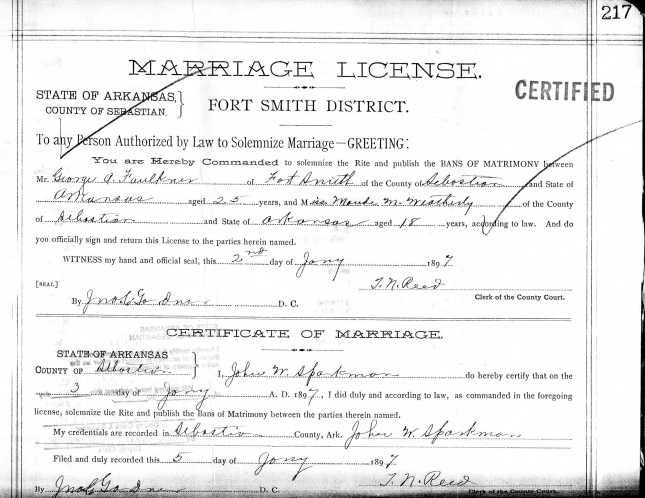
He married Maude May Weatherly on January 3, 1897 in Fort Smith, Arkansas.

They were the parents of Edna Mae Faulkner, Nettie Lee Faulkner, William Clifford Faulkner, Maggie Elizabeth Faulkner, Roy Alfred Faulkner, Daisy W Faulkner, Clyde Joseph Faulkner, Herbert Ray Faulkner, Jacob B Faulkner, Woodrow Richard Faulkner, Susie Marie Faulkner, Mamie Faulkner, and George Howard Faulkner.

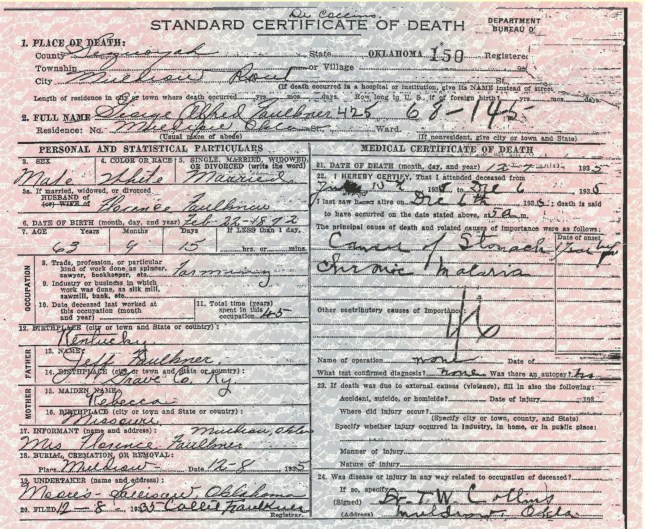
He died on December 7, 1935 in Muldrow, Oklahoma.

4-FaulknerWeatherlyMC

Marriage Certificate of George A Faulkner and Maude M Weatherly, Arkansas, Sebastian County, Marriage Book E (1895-1899), Page 217

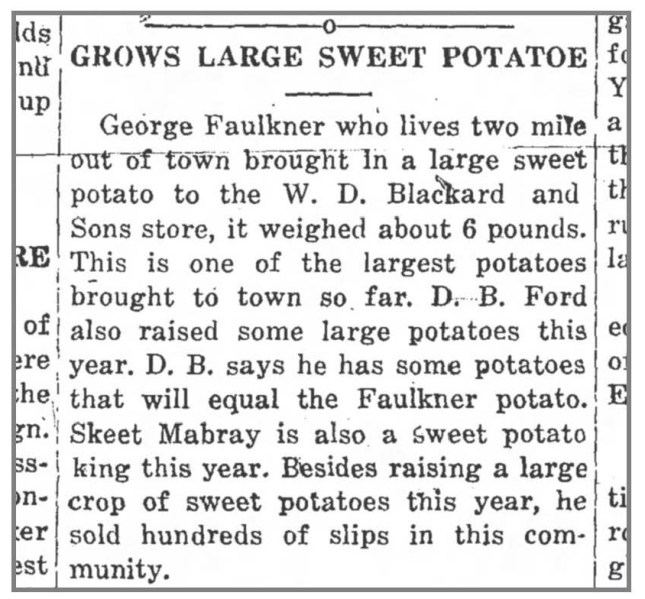
Published in The Muldrow Sun newspaper on 15 October 1926 The Muldrow Sun in Muldrow, Oklahoma.

George_Faulkner___Sweet_Potatoe_Farmer

The Muldrow Sun (Muldrow, Oklahoma) 15 October 1926, page 1, column 2

GAFaulknerDCcropped

Death Certificate of George Alfred Faulkner


The Sequoyah County Historical Society published “The History of Sequoyah County 1828-1975” in 1976. The following article was written by Margaret Blaylock and printed on page 244.

George Farmer Faulkner was born February 22, 1872. He married Maude Weatherly in 1896. She was born on March 4, 1878. They had five daughters: Edna (Faulkner) Keith, Nettie (Faulkner) Higginbottom, Maggie (Faulkner) Lee, Daisy (Faulkner) George, and Susie (Faulkner) Bentley. They had six sons: Clifford, Roy, Clyde, Herbert Ray, Woodrow, and George Howard. Herbert Ray and George Howard died when they were less than a year old. The rest of the nine children lived to be married and rear families of their own.

George and Maude reared their family in the Lone Oak area. They lived on a farm and worked hard to raise a large family and shared many hours of happiness, along with all the sorrows, of raising a family of nine. Maude (mother) died in 1918 at the age of forty. At this time there were nine children left and the family continued to struggle and rear the children. George (father) died in 1935 at the age 63. The children continued living in and around Lone Oak Community until 1940. At that time SusieNettie, Woodrow, and Edna moved to Imperial Valley, California, to find work. All nine children married residents except Susie and Woodrow. They married California residents.

Maude  and George had a total of forty-one grandchildren and several great-grandchildren. At this time there are four children living. Clifford died in 1967 at age 67. Daisy died in 1968 at age 62. Roy died in 1970 at age 66. Edna died in 1972 at age 75. Woodrow died in 1972 at age 60. Nettie and Susie are still residents of the Imperial Valley. Maggie lives in the San Joaquin Valley and Clyde lives in Missouri.

~Sequoyah County Historical Society, “The History of Sequoyah County, 1828-1975” (OK: Sequoyah County Historical Society, 1976) page 244.

 
Comments Off on George Alfred Faulkner (1872-1935)

Posted by on 15 July 2017 in Faulkner Family Farm


Faulkner Family Reunion – 1968

Published in the Big Basin Herald on 22 Aug 1968 on page 13, column 1
Family Picnic Held at Park

Faulkner_Reunion1968

Big Basin Herald (Muldrow, Oklahoma) 22 Aug 1968, page 13, column 1

 
Comments Off on Faulkner Family Reunion – 1968

Posted by on 15 July 2017 in Faulkner Family Farm


Nettie Lee Faulkner (1898-2001)

Nettie Lee Faulkner was born December 25, 1898 in Cherokee Nation, Indian Territory to George Alfred Faulkner and Maude May Weatherly.

She married William Joseph Higginbottom on December 24, 1932 in Muldrow, Oklahoma.

She died on January 3, 2001 in El Centro, California.


Nettie was the second child born into what would become a very large family. Four of the babies born to George and Maude Faulkner died in infancy, but 9 children made it to adulthood. Nettie was born into the position of tending to children, yet she would never give birth to her own.

On 24 December 1932 Nettie married Joe W Higginbottom in Muldrow, Oklahoma. On this day she also became a stepmother to three children, Mary Elizabeth Higginbottom was 11 years old, Jeanettia was 8, and Ben was 6. Their mother, Leona Merrial Higginbottom, died in Van Buren, Arkansas on October 10, 1929. Joe Higginbottom and his very young children buried her in Gracelawn Cemetery before they moved to Sequoyah County, Oklahoma.

Joe and Nettie were one of the first of the Faulkner families to move from Oklahoma to California. By April 11, 1940 they had set up a home at 837 Park in El Centro, California. Joe took a job as the Night Watchman for the State Relief of Immigration.

Nettie kept in touch with her family that stayed behind in Oklahoma. She visited them often. In 1968 she made the trip back home to attend the Faulkner Family Reunion. On May 7, 1970 the Big Basin Herald newspaper printed, “Mrs Nettie Higgenbottom is visiting with several relatives after attending her brother’s funeral, Mr Roy Faulkner. Mrs Higgenbottom is from Holtville, California.”

Nettie lived to be 102 years old. She died on 3 January 2001 in El Centro, California. The Imperial Valley Press published her obituary on 8 January 2001.

NETTIE L. HIGGINBOTTOM

Visitation will be from 6 to 9 p.m. Tuesday in Hems Bros. Mortuary Chapel in El Centro for Nettie L. Higginbottom, 102, of Holtville, who died Jan.3 in Valley Convalescent Hospital in El Centro.

Memorial services will be at 10 a.m. Wednesday in First Assembly of God in Holtville with her nephew the Rev. Art Zeigler officiating.

Burial will be in Evergreen Cemetery in El Centro.

Mrs. Higginbottom was born Dec. 25, 1898, in Oklahoma. After moving to the Imperial Valley, “Aunt Nettie” as she liked to be called, lived most of her life in Holtville. She enjoyed reading and talking about the Bible and listening to Christian radio. She was co-grand marshal of the 1999 Holtville Carrot Parade.

She was preceded in death by four brothers and four sisters, including Susie Bentley, Edna Keith and Woodrow, Clyde and Clifford Faulkner,all of Holtville.

Survivors include her sister-in-law, Dona Faulkner of Holtville; nieces, Peggy Murphy of Claypool, Ariz., Nancy Bentley of Lumberton,Texas, Phyllis Price and Shirley Bentley, both of El Centro, and Shirley Zeigler and Willie Nelson, both of Holtville; and numerous great-nieces and great-nephews.


Comments Off on Nettie Lee Faulkner (1898-2001)

Posted by on 14 July 2017 in Faulkner Family Farm


William Clifford Faulkner (1900-1967)


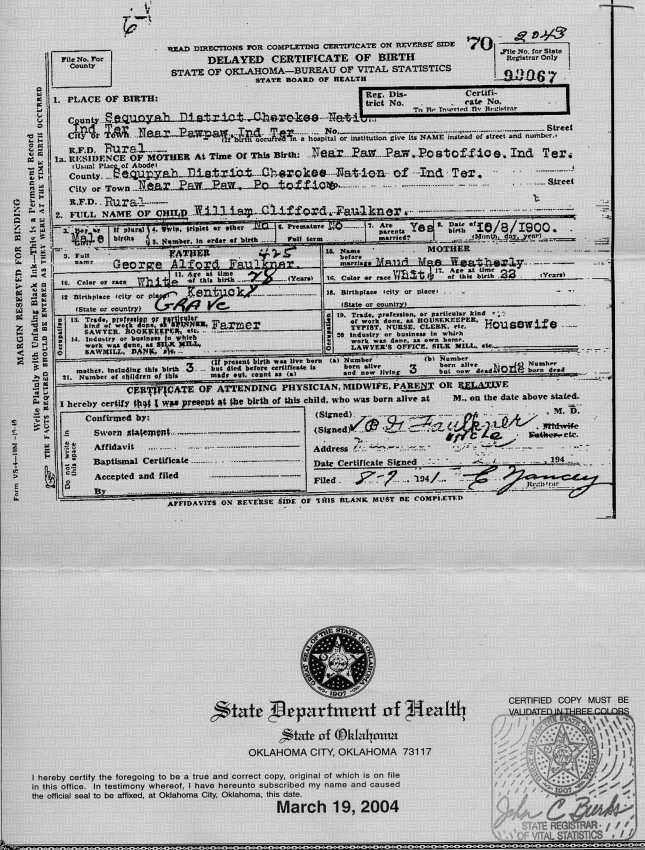
William Clifford Faulkner was born on October 8, 1900 in Sequoyah District, Cherokee Nation, Indian Territory to George Alfred Faulkner and Maude May Weatherly.

He married Mamie Belle Kidd on August 1, 1927 in Fort Smith, Arkansas.

They were the parents of Willie Mae Faulkner, William Ray Faulkner, Mildred Louise Faulkner, Maudie Irene Faulkner, and Bobby George Faulkner.

He died on August 9, 1967 in Calexico, California.


3-WCFaulknerBC

Delayed Birth Certificate of William Clifford Faulkner

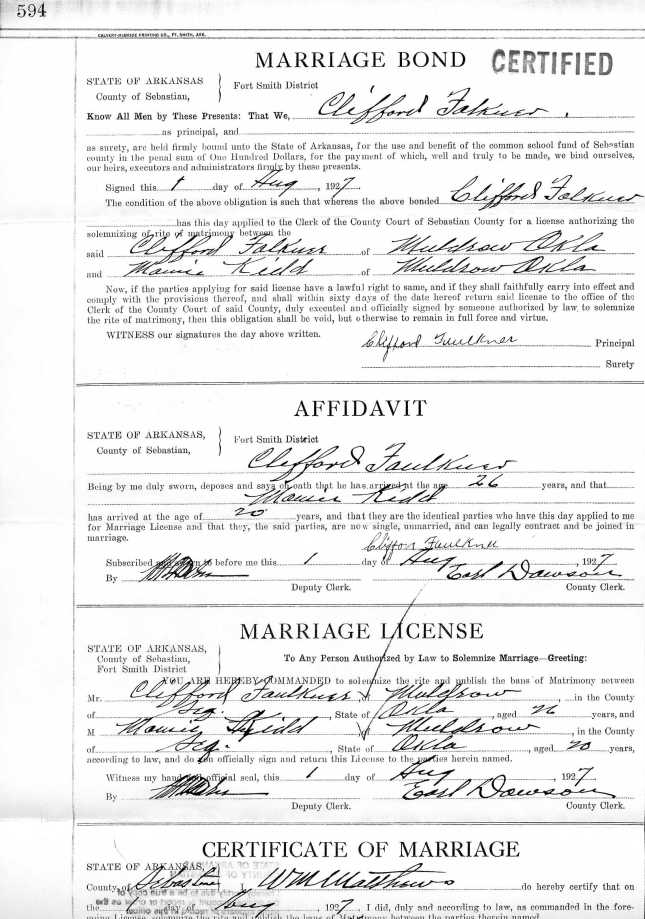
On August 1, 1927 he took his fiance’, Mamie Belle Kidd, across the state border to Fort Smith, Arkansas to get married. Fort Smith, Arkansas was the closest town to where William Clifford Faulkner lived in 1927. In 1920 Fort Smith had a population of 28,870 which was more then the entire population of Sequoyah County, Oklahoma.

3-FaulknerKiddMR

Marriage Certificate of William Clifford Faulkner and Mamie Belle Kidd from Fort Smith, Sebastian County, Arkansas Marriage Book Z, Page 594.

The first of Clifford and Mamie’s five children was born one year after they got married. They continued to build their family and live happily in the Paw Paw area, also known as Lone Oak, between Roland and Muldrow, Oklahoma. Life was not easy on the Faulkners after the 1927 wrecked havoc on the Paw Paw Bottoms.

Here is some fascinating information about the community of Paw Paw from “The History of Sequoyah County 1828-1975″ written by the Sequoyah County Historical Society and published in 1976.

William Clifford Faulkner family picture taken about 1943.

The next major flood to hit Paw Paw occurred in 1943. This was about the time that William Clifford Faulkner packed up his family and moved to California. There has been much speculation on why a family from Oklahoma ended up in southern California, and many want to blame the Dust Bowl. There is no evidence that the Dust Bowl actually impacted this area of Oklahoma, but there is also evidence that the widespread publicity of a better life for burnt out farmers was available in California.

Clifford’s sister, Nettie Higginbottom, had moved to the Imperial Valley of California before 1940. Clifford and Mamie and their five children took up residency in Holtville, California and Clifford soon became a hay cutting tractor driver.

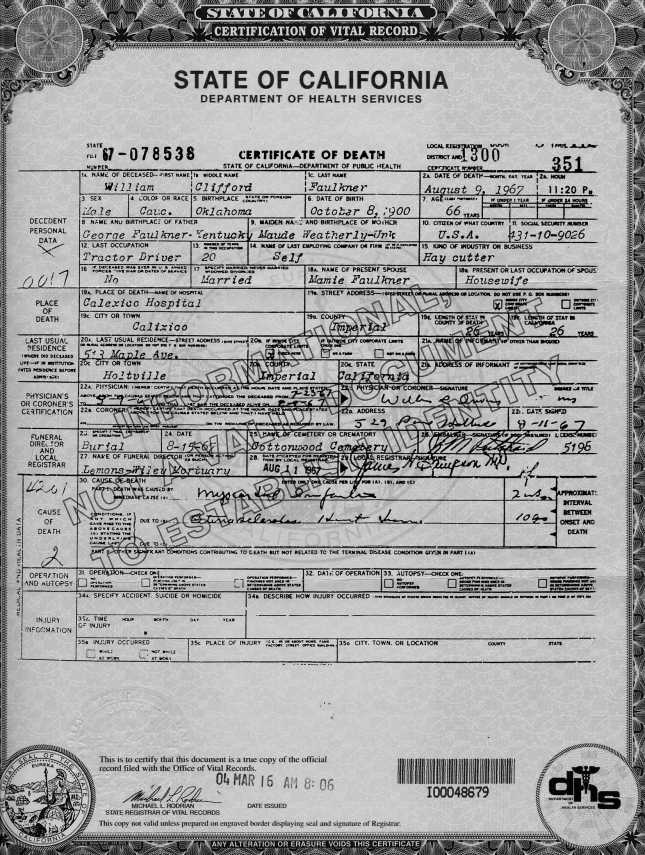
William Clifford Faulkner died on August 9, 1967 as a resident of Holtville. His body was sent to Muldrow, Oklahoma to be buried at Cottonwood Cemetery.

3-WCFaulknerDC

Death Certificate of William Clifford Faulkner


Comments Off on William Clifford Faulkner (1900-1967)

Posted by on 13 July 2017 in Faulkner Family Farm


Paw Paw by the Sequoyah County Historical Society

Reprinted from “The History of Sequoyah County 1828-1975”. Article contributed by Louise Humphrey. Published in 1976 by The Sequoyah County Historical Society.

Paw Paw took its name from the Paw Paw Society**, a semisecret organization of Southern sympathy during the Civil War. Paw Paw trees were plentiful and many took for granted it was named for the trees. It is located in Sequoyah County, seven miles southeast of Muldrow on the Arkansas River.

The early settlement boasted a blacksmith shop and a general store with a post office in the back. Land was available if one wanted the task of clearing.

The owner of the general store was called Governor Watts, a large, heavy man, who claimed most of the land along the river. He created enough interest that a few families moved in and the community started to grow.

A cotton gin was built near the river, for cotton became an industry with the good rich soil. Steamboats came from Little Rock going as far as Muskogee carrying supplies, produce and passengers. Thus the settlement made progress until the accident.

At Fort Smith (Ark.) a railroad bridge crossed the river, with a span that opened to let the steamboat through. One day the bridge failed to open and the boat broke in half and sank. The old glamour of transporting by steamboat was never regained.

The progress of Paw Paw faced a real problem of transportation. A so-called road ran on the Paw Paw side of the river to Fort Smith, but the soil was not good for roadbeds. When wet, it was almost impassable. On the other side of the river, a fair, sandy and shorter road led to Fort Smith, but to cross the wide and swift river was a problem.

A ferry was established in 1880 so the farmers could get their produce to market in Fort Smith. After the passengers reached LeFlore County, they crossed another ferry across the Poteau river to get to the city.

The Paw Paw Ferry was operated by means of rope and a pulley attached to posts on either side of the river. The boat crossed at a forty-five degree angle so that the current did most of the work. Often the rope would break and carry the boat downriver into a sand bar. None was ever seriously hurt. Fare for crossing was 40 cents round trip for wagons, ten cents for horseback riders, and five cents for a footman. The ferry carried mail and newspapers and often transported cattle. Three wagons could be carried at one time on the boat.

Several pioneer families were Marion J. Watts, R.B. Patton, Sim Claborn, J.C. Cherry, S.J. Shackelford, W.R. Langford, Sim Eldridge and Lindsey Dickey.

The earliest school was a log cabin one-room building near the graveyard. Split logs were used for benches. R.B. Patton taught in the early school. “Neighbor Tom” Watts was also a stern teacher. Before the school was built, Dr. Bruton’s wife taught in their home.

Later a two-story pine timber school house was built. Thos. F. Watts taught over 100 children a day. The school term consisted of three summer months and four or five months in the fall. This corresponded with the crops to be made and harvested.

Later in 1926 a new brick school was built with four classrooms and a large auditorium with stage, office and storage rooms. The board members whose names appear in the cornerstone are J.Y. Kidd, R.L. Condren and O.W. Green. Dewey and Prudy Patton were early teachers when Paw Paw had a two-year high school.

Mr. Parker came in and built a store near the new school, a grist mill and blacksmith appeared, and a few bought lots and houses. As the community grew, roads improved and automobiles came, phonographs, player pianos, parties and marriages, and Dr. Collins was kept busy delivering children and controlling malaria fever, and was known as a specialist in curing pneumonia. During the flood he came to see that the families were placed in secure homes and even offered monetary assistance for food or whatever was needed for their welfare.

The first three cars in the community were owned by Ulphin Cherry, Sim Eldridge and Lindsey Dickey. These cars were tried out by making Sycamore hill in high gear. If they passed this test they were sold.

A “June rise” was prevalent from the river and it continued to dominate the outcome of the community. The water would go away and they would pile more dirt on the levee. In 1927 the levee broke and the old river showed its fury. When the flood alarm was spread people quickly left their homes for high ground. They watched the river build up to a width of about fourteen miles, and some watched their homes and livestock and life’s work go away.

The valuable $200 per acre land was sold for $9 per acre to settle accounts. The community continued to survive by farming, and sharecroppers farmed the land owned by Dr. Fox. Crops consisted of cotton and corn. During the depression very little money was made after paying rent, buying seed and a few staples.

Most of the food was raised on the farm. People were fortunate to be on a farm instead of in the city on a soup line. Home demonstration agents were helpful in the community with preserving food. On washday it was quite a treat to open a jar of canned meat and have lunch with very little preparation. As usual on the farm, food was plentiful when in season. When the cows freshened there was an abundance of milk, which was kept cooled in tubs of fresh pumped water. Later in hot summer weeks an iceman hauled ice from Fort Smith, providing ice for tea on the menu.

The early schoolhouse was also used as a community church. Different preachers of different faiths alternated each Sunday. The crowds were the same and the Union Sunday School literature was sufficient for all.

One of the main events of the year, besides Christmas, was Decoration Day. This fell on Mother’s Day. It was an all-day affair with preaching, decorating of graves, dinner on the ground, and a Mother’s Day program in the afternoon. This is still the custom but the programs are not as extensive, since all the families live elsewhere. During rehearsals in preparation for the program, you would hear of “decoration dresses,” “Sunday slippers” or “oxfords” being purchased new for the event. More often than not, the person in charge of the program was a school teacher who seemed to find “pieces” for all to recite.

This even taught the children respect for the dead. Flowers were gathered the day before in meadows and roadsides wherever wild flowers were available. Mrs. Hixson took children on a flat bed truck and picked the flowers. When the day arrived everyone came in their “finery” and carried a basket lunch. After the morning message by the preacher, the children were lined up “two by two.” The entire cemetery was decorated by the children, while the women were busy spreading the dinner on the ground. Tablecloths were laid on the ground and food was spread next to a neighbor or relative.

Everyone showed respect for their elders. It was not uncommon to call them “Uncle and Aunt” whether or not they were relatives. Some of these were Aunt Fanny Dickey, Aunt Nan Cherry, Uncle Tom Bailey, Aunt Jessie Shackelford, Uncle John Shackelford, Aunt Maggie Watts, Aunt Betty and Uncle Allen Blaylock, Uncle Will and Aunt Lillie Patton, Uncle Henry and Aunt Myrtle Shackelford.

The community continued to grow and the school doubled in size with two teachers in each room. This was made possible by bussing the children from Elm Grove and outlying areas of the Paw Paw school district. There were good ball teams and track meets where Paw Paw was able to compete with any school in the county. At one time a grade school girls’ basketball team coached by Clarence McDole defeated Sallisaw High School’s “B” team at a county tournament. But annexation caused the school to lose their attendance area.

The river never ceased to hold a threat over the community and in 1943 the old river showed its fury, complete, total, final. In its wake lay the death of a beautiful community.

There were other floods that covered the entire bottom. Today there are sink holes that stand on the landscape as mute evidence of terrible floods in years gone by.

Today the real danger of bad floods is past because of the controlled waters of the river through upper stream dams and the McClellan-Kerr Navigation System on the Arkansas River.
 
Comments Off on Paw Paw by the Sequoyah County Historical Society

Posted by on 13 July 2017 in Faulkner Family Farm